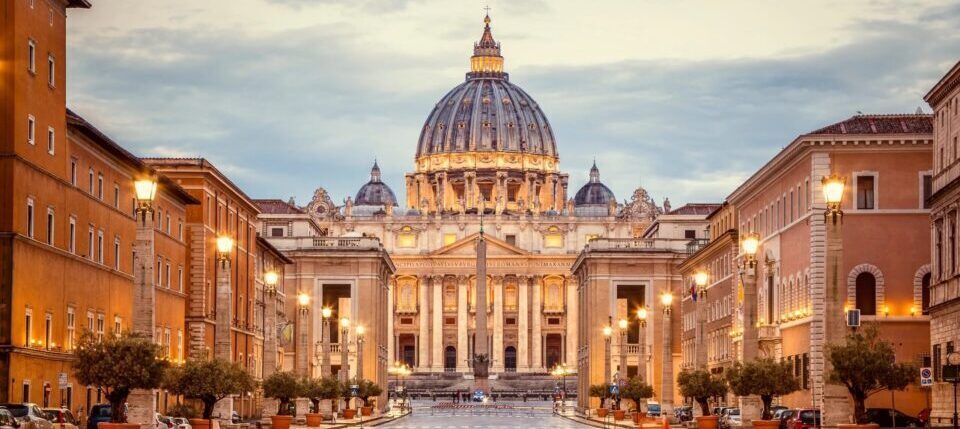
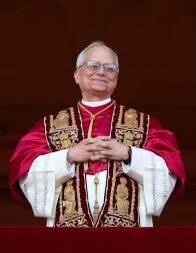
On 27 May 2025, the Vatican’s Philatelic and Numismatic Office released its first official postage stamps featuring Pope Leo XIV. The series comprises four stamps, each capturing key events from the initial phase of his pontificate. The €1.25 and €2.45 stamps depict Pope Leo XIV’s first public appearance on the balcony of St Peter’s Basilica on 8 May, immediately following his election. The €1.30 and €3.20 stamps showcase moments from the Mass he celebrated with the College of Cardinals in the Sistine Chapel on 9 May.
A total of 390,000 stamps were printed, each bearing the Latin inscription “Leone PP. XIV” and the notation “Anno I S.P. MMXXV,” indicating the first year of his pontificate.
The release of the stamps follows the issuance of sede vacante stamps, which marked the period between Pope Francis’s death and the election of his successor. The sede vacante stamps, which traditionally feature the coat of arms used during the interregnum (the umbraculum and the crossed keys of St Peter), were valid for postage until the new pope’s inauguration.
The Vatican began using its own postage stamps on 1 August 1929, shortly after the Lateran Treaty established the Vatican City State as an independent sovereign entity on 11 February 1929.
The first set of Vatican stamps, known as the “Conciliation” issue, was jointly produced with Italy and featured religious and state imagery. These stamps marked the beginning of the Vatican’s independent postal system, which operates separately from the Italian postal service and is administered by the Philatelic and Numismatic Office of Vatican City.
For those interested in acquiring the Pope Leo XIV stamps, they are available for purchase at Vatican post offices and will soon be accessible online through the Vatican’s official philatelic website.
The Archdiocese of Chicago, hometown of Pope Leo XIV, is hosting an event in the city’s Rate Field, residence of its beloved White Sox baseball team, to celebrate the election to the papacy of a native son.
By Vatican News
The US city of Chicago, Pope Leo XIV’s hometown, is preparing to celebrate his election with a day of prayer and music.
The meeting, which will take place in Chicago’s Rate Field, is described by the Archdiocese of Chicago – hosting the event – as one of faith, unity, and community spirit.
In a post on X the Archdiocese wrote: Join us at Rate Field – Home of the @WhiteSox for a once-in-a-lifetime celebration of the election of Pope Leo XIV on June 14. Get your tickets now at https://ticketmaster.com/event/040062AB8F6B11DB
Rate Field is the city’s baseball stadium, home ballpark of Major League Baseball’s Chicago White Sox.
Gates will open at 12:30 on Saturday, June 14, with the programme beginning at 2:30 pm, ending with Holy Mass, presided over by Cardinal Blase Cupich, Archbishop of Chicago, at 4:00 pm local time.
The election of Pope Leo XIV came at the end of my first and last conclave. Having been made a cardinal by Pope Francis in 2014, I had never before been part of the process – and as I turn 80 in a few months’ time, please God I shall not be again. I was relieved to discover that the reality of a conclave was nothing at all like Edward Berger’s recent film. During this conclave, with 133 cardinals present, there was no rancour between us, nor any kind of politicking by which someone might have tried to promote themselves or block someone else. It was, in fact, at times marked by fraternal unity and prayerful discernment.
When we gathered in the Casa Santa Marta and the Sistine Chapel, the demands of total isolation from the outside world were fully observed. Not only did I have to make do without my mobile phone or any other electronic device, even my electric toothbrush was given a quick glance by the relevant officials. No one was taking any chances.
There has been a lot of speculation about why the first vote took so long. The answer is quite straightforward. The procedure by which each of the 133 cardinals took a solemn oath to maintain the secrecy of our conversations took longer than expected. And then Cardinal Raniero Cantalamessa, the former Preacher to the Papal Household, delivered a meditation that was inspiring and somewhat lengthy. Then, of course, the formal process of each cardinal, individually, casting a ballot, and the counting of them, took a long time.
At this point, I realised the need for patience. We were part of a process, established in its current form for several centuries, which would need to run its course. We meticulously followed every step to the letter. This could have been irritating – but it became an opportunity for quiet reflection.
I learned a lot about some of my brethren, gathered from five continents and 70 countries, many of whom I had not met before. For example, Cardinal Giorgio Marengo, the youngest member of the conclave, told me about his work in Mongolia. Some of his churches are tents that move with the people, and he moves with them. The peripheries to which Pope Francis was devoted were well represented, as he intended.
I was only a few feet away from Cardinal Robert Prevost when it became clear that his name had reached the required two-thirds majority to see him elected to the papacy. Cardinal Pietro Parolin – the Vatican’s Secretary of State, who was tasked with running the conclave – asked him: “Do you accept your election as Supreme Pontiff?” His response was calm, and given with great deliberation: “I accept.”
For a little while longer, only 132 people in the world knew for whom they should now pray as Pope. Cardinal Parolin then asked Cardinal Prevost by what name he wished to be known. “I am to be called Leo,” he replied. Then he withdrew to pray and to be vested, while the ballots were burned with the special chemicals that produce the white smoke and a message was sent to the basilica for the bells to be rung.
And with that, we were free once more. No sooner had the news been announced to the world by Cardinal Dominique Mamberti from the central balcony, the speculation began about what kind of papacy this will be. Much of that remains to be seen, but what is certain is that the man we elected has a rare combination of talents which made it clear that he could bring the right depth of experience to the office at this time.
Pope Leo is, after all, a citizen of the world. He was Prior General of the Augustinians twice, a role that took him all over the globe to understand and direct its international work. He has been a teacher, and also has a doctorate in canon law – so he knows how things ought to be done. He was a diocesan bishop in Peru, where sometimes he had to visit his people on horseback, and has been a member of the Roman Curia.
He also has a very gentle manner – and although he thinks clearly and can be decisive, I have seen him resolve difficulties without leaving enemies behind him. After he accepted the result of the election, a loud round of applause broke out; once he appeared on the balcony, the relatively peaceful atmosphere of the conclave gave way to very real excitement and delight. Outside, the Romans welcomed their new bishop with gusto.
For the rest of the week, Rome did what Rome does so well – it threw a party. The atmosphere in the city was enhanced by the presence of the various bands who were already there ahead of the special Jubilee of Bands and Popular Entertainment, which had long been planned for that weekend. Pope Leo welcomed them particularly during his first Sunday address – the timing seemed almost providential.
What has become clear, as the days and weeks have passed, is that Pope Leo views his office through the lens of service. Human dignity, connections between people, the bedrock of faith in Christ that underpins our common life – these are all on his list of priorities. Dialogue with those of a wide range of beliefs and viewpoints is also to the fore; so too, evidently, is an appreciation of the sheer joy with which the gift of life can be infused.
Of course, there will be challenges ahead. The powerful will continue to need to be reminded of their responsibilities towards the vulnerable, and across the world – including in the UK – governments will need to be recalled to an understanding of the essential dignity that belongs to each and every person, given to them by God, at all stages of life and in every circumstance. He will need to speak to a world that is all too often forgetful of the boundless mercy of God.
“Peace be with you!” exclaimed Pope Leo after he appeared on the balcony for the first time. It is the greeting of bishops to their people, and the greeting of the Risen Lord to His apostles. We have been given a Successor of Peter who radiates calmness, stability and a profound dedication to the Lord – but I think also one with a good sense of humour and a real zest for life. The conclave is over and the seat is no longer vacant. Thanks be to God.
Pope Leo XIV gives his blessing at the conclusion of Mass and the recitation of the “Regina Coeli” marking the Jubilee of Families, Children, Grandparents and the Elderly in St. Peter’s Square at the Vatican June 1, 2025. (CNS photo/Lola Gomez)
(OSV News) — This is the full text of the Regina Caeli address given by Pope Leo XIV June 1 after a Mass for the Jubilee of Families, Children, Grandparents and the Elderly in St. Peter’s Square.
At the conclusion of this Eucharistic celebration, I offer a cordial greeting to all those participating in the Jubilee for Families, Children, Grandparents and the Elderly! You have gathered here from every part of the world, with delegations from 131 countries.
I am particularly happy to welcome so many children, who restore our hope! I greet all the families, which are small domestic churches where the message of the Gospel is received and passed on. The family, Saint John Paul II said, “has its origin in that same love with which the Creator embraces the created world” (Letter to Families Gratissimam Sane, 2). May faith, hope and love always increase in our families. In a special way, I greet grandparents and the elderly, you are models of genuine faith and an inspiration for the younger generation. Thank you for coming!
I extend my greeting to all the pilgrims present, especially those from the Diocese of Mondovì, in Piedmont.
Today in Italy, and in many parts of the world, the Solemnity of the Ascension of the Lord is being celebrated. It is a beautiful feast, which makes us look forward to the goal of our earthly journey. In this regard, I would note that yesterday, in Braniewo, Poland, Cristofora Klomfass and fourteen other Sisters of the Congregation of Saint Catherine Virgin and Martyr, were beatified; they were killed in 1945 when the Red Army invaded Poland. Despite a climate of hatred and of terror against the Catholic faith, they persevered in their service to the sick and orphans. Let us commend to the intercession of the new Blessed Martyrs all those women religious throughout the world who devote themselves generously for the sake of God’s Kingdom.
I also recall that today is World Communications Day, and I thank media professionals who, by ensuring the ethical quality of their messages, help families in their educational task.
May the Virgin Mary bless families everywhere and sustain them in their trials. I think especially of those families suffering due to war in the Middle East, in Ukraine and in other parts of the world. May the Mother of God help us to press forward together on the path of peace.
Pope Leo XIV addresses the pack of cyclists passing by the Vatican during the 21st and last stage of the 108th Giro d’Italia cycling race, 205km from Verres to Sestriere. Vatican Media/IPA via ZUMA Press/dpa
Jun 1, 2025 at 11:58 AM EDT
The Giro d’Italia peloton was blessed by Pope Leo XIV ahead of its final day of competition on Sunday.
The Pope greeted the field before the start of the 143-kilometre stage, which began in Vatican City to pay tribute to the new leader of the Catholic Church and bid farewell to Pope Francis, before entering the official circuit.
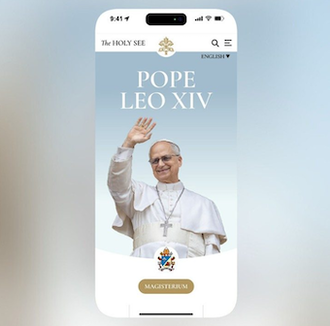
The Holy See’s official website Vatican.va has been given a new, modern design, presenting papal teaching to the world in a more accessible format, according to the Dicastery for Communication.
The portal seeks to bring the Papal Magisterium and the heart of the Catholic Church closer to the whole world.
A new homepage – designed to offer a clearer and more accessible browsing experience – now welcomes visitors, who will be able to navigate more easily among the documentation of the Magisterium, both that of Pope Leo XIV and his predecessors.
The homepage update is part of an extensive editorial and development effort, structured in several stages with the goal of transferring the site’s immense historical heritage – online since December 1995 – into a renewed portal.
To make these pages accessible, teams with diverse skills have worked and continue to work together: the Documentation Group, which ensured all content is accessible, and the informatics team of the Dicastery, which developed the structure.
It brings to life the project of Peruvian graphic designer Juan Carlos Yto (TMB.Lab), an alumnus of the first group of the Faith Communication in the Digital World program run by the Dicastery for Communication.
In a statement on the Dicastery’s website, Mr Yto explained the portal design and his goal behind the new look. He said: “It must represent the embrace of the Church in the digital world. It was the first thing that came to mind when I heard about the intention to renew the official website of the Holy See.
“Following the spirit and the elliptical shape of Gian Lorenzo Bernini’s St Peter’s Square: a Church with open arms, universally accessible and updated for modern times.
“A clearer, more approachable, and contemporary Church.
“The colours are inspired by the Roman sky blue, which contrasts beautifully with the warm tones of travertine. Sky and earth. Stone and depth.
“Golden accents of divinity, light grays, and white to illuminate.
“Larger and more prominent photographs on the homepage, to show a living and constantly moving Church.”
The announcement concludes: “Blessed browsing to all!”
Pope Leo XIV joins the faithful at the conclusion of the prayer of the Rosary in the Vatican Gardens, to mark the end of the Marian month.
By Francesca Merlo
Saturday 31st of May marked the end of the Marian month – the month dedicated to the Virgin Mary. At 8pm Rome time, the faithful gathered outside the Church of Santo Stefano degli Abissini in the Vatican, where they began a candlelit procession, praying the Rosary together as they made their way up to the Grotto of Lourdes.
The procession followed the path of the Joyful Mysteries, with each stop recalling a key moment in the life of Jesus and Mary: the Annunciation, the Visitation, the Nativity, the Presentation in the Temple, and the Finding of Jesus in the Temple.
At the conclusion of the procession, Pope Leo XIV joined those present at the Grotto and gave a short address. He first expressed his joy at being part of the vigil, describing it as “a gesture of faith through which, in a simple and devout way, we gather under the maternal mantle of Mary”.
He noted that the vigil reflected the spirit of the Jubilee Year, with its focus on praise, journey, hope, and faith, before recalling the words of Saint John Paul II, who described the Rosary as a prayer with “a Marian character and a Christological heart” that reflects the depth of the Gospel message.
The Holy Father then went on to encourage everyone to look at their lives as a journey of faith. “Let us then look at our lives as a journey following Jesus, to be walked, as we did this evening, together with Mary”, he said, before inviting the faithful to ask the Lord for the grace to praise Him daily, not only in words but in the way they live.
Finally, the Pope took the opportunity to thank all those present, including Cardinals, Bishops, priests, and consecrated persons. He made special mention of the Benedictine Sisters of the Mater Ecclesiae Monastery, thanking them for their “affection and gratitude” as they “support our community and our work with their hidden and constant prayer”.
He concluded by sharing his hope that the peace and unity experienced during the vigil would remain with all participants, at home, in their communities, and in their service to the Church.
Pope Leo XIV celebrates an ordination Mass in St. Peter’s Basilica, and urges priests to welcome God’s grace so they might remain close to the people they serve as credible witnesses.
Two days after Pope Leo XIV sent a telegram to the CELAM bishops, they share their commitment to his pontificate and call his election “a sign of hope.”
By Kielce Gussie
Marking their 40th Ordinary General Assembly, the Latin American and Caribbean Episcopal Council (CELAM) sent a letter to Pope Leo XIV. In it, they express their joy at his election as the 266th Successor to St. Peter and their gratitude for the telegram he addressed to the Assembly two days ago.
“With hearts filled with joy, we, the participants of the 40th Ordinary Assembly of the Latin American and Caribbean Episcopal Council (CELAM), gathered in Rio de Janeiro, send you our fraternal greetings and heartfelt thanks for the message with which you have encouraged our episcopal ministry.”
Pope Leo’s election is a sign of hope
In their message to the Pope, the CELAM bishops stated they see in his election, “the providential work of God.” In the wake of fruits of Francis’ pontificate, the letter continued, “your election is a sign of hope.”
The bishops affirmed their renewal of their “full and filial communion” with the Pope and stress their commitment to serving as a missionary Church. “We humbly embrace the challenge of being a servant Church, one that enriches the center from the periphery, and proclaims with authenticity from a place of simplicity.”
Do not forget Latin America and the Caribbean
While the CELAM bishops are holding their 40thGeneral Assembly, they are also commemorating the 70th anniversary of the First General Conference of the Latin American Episcopate in Rio de Janeiro in 1955. In light of this, the bishops reiterated their dedication to evangelization.
The bishops also pointed out the challenging sociopolitical reality of the region, saying it needs the Pope’s “prophetic voice to inspire justice and peace.” As families and communities face armed conflict, drug trafficking, and forced migration, the Assembly petitioned Pope Leo to remember the region in his prayers.
“Migrants yearning for a dignified future, Indigenous peoples defending their identity and land, youth without opportunities, women victims of violence, abandoned and vulnerable children… all of them await from us words and gestures that comfort and liberate.”
The bishops’ letter stressed their ongoing commitment to continuing the missionary and synodal mission of the Church and underscored their dedication to caring for all of Creation, following the legacy of Laudato si’.
Concluding their letter, the bishops formally invite Pope Leo XIV to visit Latin America and the Caribbean whenever he can as “our people long for your presence and apostolic blessing.”