The bishop of Rome is one of many titles held by the pope.
On his way to the St. John Lateran Basilica for the final steps to take on the role of bishop of Rome, the pope stopped at Piazza Venezia in the center of Rome to meet with the mayor of the city, Roberto Gualtieri.
Speaking before a crowd, Gualtieri said the city of Rome is ready to accompany the pontiff “to affirm the paradigm of a new politics,” and ended his speech by welcoming him: “We are happy that Rome is now your city,” as translated by Vatican News.
During his Regina Caeli address, Pope Leo XIV remembers Jesus’ call for our hearts to not be troubled and urges us to walk in the joy of the faith, while also expressing appreciation for the affection the faithful have been offering him.
By Deborah Castellano Lubov
In his first Regina Coeli address from the window of the Apostolic Palace, Pope Leo XIV reminded the faithful that God takes us by the hand, and invited us to not allow ourselves to be troubled but to walk with joy in the faith.
The Holy Father began his address expressing gratitude. “Just a few days ago,” he recalled, “I began my ministry among you, and first of all, I want to thank you for the affection you are showing me, while I ask you to support me with your prayers and closeness.”
Large crowds gathered in St Peter’s Square for the Regina Coeli (@Vatican Media)
We need not rely on our own strength
In his catechesis, the Holy Father recognized that “in all that the Lord calls us to—whether in our life journey or in our journey of faith, sometimes we feel inadequate.”
However, he said, Sunday’s Gospel reading, from St. John, “tells us that we should not rely on our own strength, but rather on the mercy of the Lord who has chosen us, certain that the Holy Spirit guides us and teaches us everything.”
With this in mind, the Holy Father reminded the faithful that the Lord offers comfort and peace even amid anxiety and distress.
“To the Apostles, who on the eve of the Master’s death are troubled and distressed,” wondering how they would be able to continue and bear witness to the Kingdom of God, Pope Leo said, “Jesus announces the gift of the Holy Spirit with this wonderful promise: ‘Whoever loves Me will keep My word, and My Father will love him, and We will come to him and make Our dwelling with him.’”
Do not let your hearts be troubled
In this way, the Holy Father noted, Jesus frees the disciples from all anxiety and worry, reassuring them, “Do not let your hearts be troubled and do not be afraid.”
In this sense, Pope Leo said, “If we remain in His love, He Himself dwells in us—our life becomes a temple of God,” and this love enlightens us, “shaping the way we think and the choices we make,” spreading to all aspects of our existence.
Pope Leo XIV leads the faithful in singing the Regina Caeli (@Vatican Media)
God takes us by the hand
This indwelling of God in us, the Pope suggested, is precisely the gift of the Holy Spirit, “who takes us by the hand and enables us to experience—even in our daily lives—the presence and closeness of God, making us His dwelling place.”
The Holy Father observed, “It is beautiful that, when we look at our calling, at the realities and people entrusted to us, at the commitments we carry out, and at our service in the Church, each one of us can confidently say: even though I am fragile, the Lord is not ashamed of my humanity.
“On the contrary,” Pope Leo explained, “He comes to dwell within me. He accompanies me with His Spirit, enlightens me, and makes me an instrument of His love for others, for society, and for the world.”
‘Let us walk in the joy of the faith’
With this in mind, the Pope said, “let us walk in the joy of faith,” in holiness, and, “let us commit ourselves to bringing His love everywhere.”
THE WRITER addresses a conference in Zagreb, which he initiated as ambassador in 2019, marking the 25th anniversary of the establishment of diplomatic relations between the Vatican and the State of Israel. (photo credit: Ilan Mor)
The new pope is aiming to bolster relations between the Catholic Church and Jerusalem.
On May 8, just days after his election, Pope Leo XIV sent a remarkable signal to the Jewish world: In a personal letter to Rabbi Noam Marans, director of Interreligious Affairs at the American Jewish Committee (AJC), he reaffirmed his “commitment to continue and strengthen the Church’s dialogue and cooperation with the Jewish people in the spirit of the Second Vatican Council’s 1965 declaration Nostra Aetate. This message, sent even before his formal inauguration, was more than diplomatic protocol; it was a deliberate gesture of outreach at a time of strained relations.
This letter stands in the tradition of a historic turning point that began with the Nostra Aetate. In this landmark document, the Catholic Church for the first time explicitly rejected the doctrine of collective Jewish guilt for the crucifixion of Jesus. It also emphasized Christianity’s deep spiritual roots in Judaism and called for respectful dialogue, becoming a watershed in the relationship between the two religions. This reevaluation was not only theological but also a moral response to the Holocaust and the need to confront historical guilt, setting the stage for decades of rapprochement.
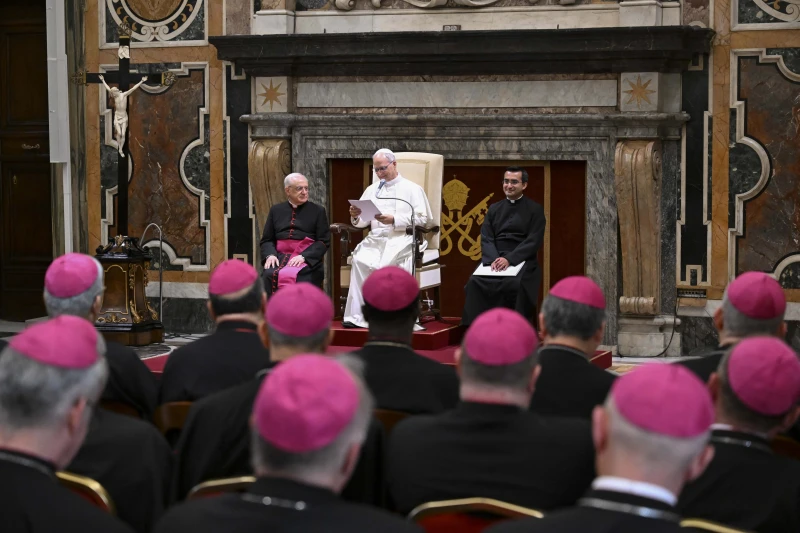
It marked the Holy Father’s first encounter since being elected Pope with officials of the Roman Curia, and the employees of the Holy See, the Governorate of Vatican City State, and the Vicariate of Rome.
Recognizing that each, in his or her own way, collaborates in the Successor of Peter’s work, the Pope warmly welcomed those gathered, and expressed his gladness.
“Each one contributes by carrying out their daily tasks with commitment—and also with faith, because faith and prayer are like salt in food: they give it flavor.”
The Holy Father also said he was very glad that many family members were also present, “taking advantage of the fact that today is Saturday.”
This first meeting of ours, Pope Leo XIV noted, is “certainly not the occasion for programmatic speeches,” but rather “an opportunity for me to thank you for the service you carry out, and this service, which I, so to speak, ‘inherit’ from my predecessors.”
The Holy Father pointed out that he arrived only two years ago, “when the beloved Pope Francis appointed me Prefect of the Dicastery for Bishops.” At that time, he recalled that he left the Diocese of Chiclayo in Peru and came here to work.
“What a change! And now… what can I say? Only what Simon Peter said to Jesus by the Sea of Tiberias: ‘Lord, you know everything; you know that I love you,'” he reflected.
Pope Leo receives curial officials (@VATICAN MEDIA)
Popes come and go, Curia remains
“Popes come and go; the Curia remains,” Pope Leo observed.
This, he said, applies in every particular Church, to diocesan Curias, and it applies as well to the Curia of the Bishop of Rome. “The Curia is the institution that preserves and transmits the historical memory of a Church, of the ministry of its Bishops,” he noted, saying, “This is very important.”
Memory, he reiterated, is an essential element in a living organism, and is not only oriented toward the past, but nourishes the present and guides the future. “Without memory,” he said, “the path becomes lost, the journey loses its meaning.”
Cannot thank the Lord enough for vocation
Working in the Roman Curia, he said, means helping to keep alive the memory of the Apostolic See, so that the ministry of the Pope may be carried out in the best possible way. And by analogy, he added, the same can be said of the services of the Vatican City State.
He then highlighted the missionary dimension of the Curia and of every institution linked to the Petrine ministry, complementary to that of memory,.
“As you may know,” he shared, “the experience of mission is part of my life—not only as a baptized person, as it is for all Christians—but also because, as an Augustinian religious, I was a missionary in Peru. It was among the Peruvian people that my pastoral vocation matured.”
“I can never thank the Lord enough for this gift!”
“Leo XIV: Portrait of the First American Pope,” written by Matthew Bunson, vice president and editorial director at EWTN News. | Credit: Daniel Ibáñez/CNA
EWTN officially launched the first authoritative biography of Pope Leo XIV, which is available for purchase now, during an event at the Vatican on May 22.
“Leo XIV: Portrait of the First American Pope,”written by Matthew Bunson, vice president and editorial director at EWTN News, tells the story of Chicago-born Cardinal Robert Prevost, who was elected the new Holy Father on May 8.
Bunson, a Church expert and longtime Vatican journalist who has written over 50 books, said at the book launch at the Campo Santo Teutonico in Rome that Leo’s diverse experience as a pastor, prior general, missionary and bishop in Peru, and as a cardinal have given him a profound understanding of the global Church.
The route, known as “Paths of Pope Leo XIV,” highlights the places where the Holy Father — formerly known as Bishop Robert Prevost — exercised his fruitful pastoral ministry in the Andean nation.
The route covers four of the country’s regions: Lambayeque, Piura, La Libertad, and Callao, key locations in the ministry of the man who is now Pope Leo XIV, the first Peruvian citizen to become pope.
The Pope has offered to host Russia-Ukraine peace talks at the Vatican, the Italian prime minster, Giorgia Meloni, has said after speaking to the newly elected pontiff by phone.
“The prime minister thanked Pope Leo for his offer and for his serious commitment to peace,” Meloni’s office said.
In a statement, her office added Meloni had been asked to contact the Pope during a call with President Trump and European leaders on Monday, the same day Trump discussed peace plans with President Putin.
Giorgia Meloni was at St Peter’s Square on Sunday for the Pope’s inaugural mass
ALBERTO PIZZOLI/AFP/GETTY IMAGES
Trump said on Monday “it would be great” for Russia and Ukraine to sit down for talks at the Vatican. The Pope said last week: “The Holy See is always ready to help bring enemies together, face to face, to talk to one another.”
The Kremlin spokesman, Dmitry Peskov, said Russia welcomed “the readiness and efforts of all parties who want to contribute to a speedy settlement”, but said no proposal had yet been received from the Vatican.
Pope Leo XIV holds his first Wednesday General Audience and reflects on Jesus’ parable of the sower, stressing that God “does not wait for us to become the best soil.”
By Kielce Gussie
In his first General Audience as Pontiff, Pope Leo XIV continued with Pope Francis’ Jubilee series on the theme of “Jesus Christ, Our Hope.”
The new Pope carried on with his predecessor’s reflection on the parables of Jesus, which Pope Leo said “help us to rediscover hope, because they show us how God acts in history.”
A unique parable
Pope Leo focused on the parable of the sower—“a rather unique parable, as it serves as a kind of introduction to all the others.” He pointed out how this story reveals how Jesus communicates, and it can give us guidance on how to proclaim the Gospel today.
While parables are taken from everyday life, their goal is to convey something more profound. They encourage us all to “raise questions within us; they invite us not to stop at appearances.”
Reflecting on the story, the Pope urged everyone to ask themselves two questions: Where am I in this story? What does this image say to my life?
A sower goes out to sow
In this parable of the sower, Pope Leo XIV explained that we can see God’s power and the impact it has on us.
“Every word of the Gospel is like a seed sown in the soil of our lives,” he shared, highlighting that the soil is not only our heart, “but also the world, the community, the Church.” There is no aspect of life that remains untouched by the Gospel.
Pope Leo greeting pilgrims in the popemobile during his first General Audience (@Vatican Media)
People from all walks of life and backgrounds came out to listen to Jesus tell this parable. This shows us that “Jesus’ word is for everyone, but it works in each person differently,” which Pope Leo explained helps us understand the parable better. Each of us can draw something from the parable no matter our situation in life.
Jesus is the Seed
In the story, where the seeds fall seems to be of little concern to the sower, which the Pope pointed out symbolizes how God loves each and every one of us. “We are used to calculating and planning things, but love doesn’t work that way,” he said.
Pope Leo emphasized that God “scatters the seed of His word on every kind of soil—meaning, in every one of our situations.” Whether we receive it with enthusiasm, superficiality, or fear, God trusts that at one point or another the seed will bear fruit.
God “does not wait for us to become the best soil.” Rather, He gives us His word over and over again, and His word is Jesus.
Van Gogh and his sunset
Closing his reflection, Pope Leo XIV pondered Vincent van Gogh’s painting, The Sower at Sunset.
“What strikes me,” he shared, “is that, behind the sower, van Gogh painted the grain already ripe.” The Pope called this an image of hope that somehow the seed has borne fruit.
In the center of the painting is the sun—not the sower, which reminds us that “God drives history, even if He sometimes seems distant or hidden.”
Remembering Pope Francis
Before praying the Our Father in Latin, Pope Leo XIV remembered his predecessor, Pope Francis, on the one month anniversary of his passing.
“And we cannot conclude our encounter without remembering with such gratitude our beloved Pope Francis, who exactly one month ago returned to the house of Our Father.”
Pope Leo XIV makes a surprise visit to the Dicastery for Bishops – where he had served as Prefect until he was elected Pope – and celebrates Mass in the Dicastery’s chapel.
By Vatican News
The Holy See Press Office announced that Pope Leo XIV made a surprise visit on Tuesday morning to the Dicastery for Bishops, where he had served as Prefect since his January 2023 appointment until his 8 May election as Pope.
During his visit, the statement noted, Pope Leo celebrated Mass in the Dicastery’s chapel.
The Holy Father arrived at the Dicastery’s offices in Piazza Pio XII around 10 a.m. in the dark minivan that has already been seen during his visits outside the Vatican.
Notably, it has been spotted during Pope Leo’s May 10 excursion south of Rome to pray at the Shrine of Our Lady of Good Counsel in Genazzano, and exactly one week ago, at the Augustinianum, where he celebrated Mass and had lunch with his Augustinian confreres.
Today, marked the Pope’s third surprise outing.
The Holy Father was greeted by applause; and a small crowd gathered in the Square, a few meter’s from the colonnade of St. Peter’s, were chanting “Viva il Papa!”
Others had waited along Via dei Corridori, parallel to Via della Conciliazione, behind the building, to see the Pope’s car emerge from the garage after about an hour and a half.
The Dicastery for Bishops is responsible for all matters pertaining to the establishment and provision of particular Churches and to the exercise of the episcopal office in the Latin Church, without prejudice to the competence of the Dicastery for Evangelization.
This afternoon, the Holy Father will travel to the Basilica of St. Paul Outside the Walls to pray at St. Paul’s tomb.
On Wednesday morning, Pope Leo will hold his first General Audience with the faithful in the Vatican.