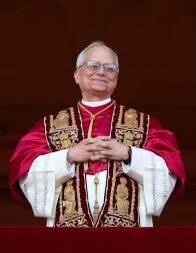
Pope Leo calls for prayers for peace and for those suffering due to war
13 Sunday Jul 2025
NEWS
13 Sunday Jul 2025
NEWS
13 Sunday Jul 2025
NEWS
Pope Leo XIV says the world needs a “revolution of love” and looked at the Parable of the Good Samaritan while celebrating Mass at the Parish of St. Thomas of Villanova in Castel Gandolfo, a lakeside town outside of Rome.
The pontiff began a short vacation in the town last Sunday, re-beginning a papal tradition skipped by Pope Francis, who had preferred to stay at the Vatican in Rome for the summer.
Speaking about the parable in the Gospel of Luke, Leo said it was “so challenging for each of us.”
In the parable, Jesus was asked, “Who is my neighbor?”
Jesus replied with the story of a man was going down from Jerusalem to Jericho and was attacked by robbers. After not being helped by two passing Jews – one a priest and one a Levite – a Samaritan saw him, helped with his wounds and took him to an inn for safety.
“If Christ shows us the face of a compassionate God, then to believe in him and to be his disciples means allowing ourselves to be changed and to take on his same feelings. It means learning to have a heart that is moved, eyes that see and do not look away, hands that help others and soothe their wounds, shoulders that bear the burden of those in need,” Leo said.
“If we realize deep down that Christ, the Good Samaritan, loves us and cares for us, we too will be moved to love in the same way and to become compassionate as he is. Once we are healed and loved by Christ, we too can become witnesses of his love and compassion in our world,” the pope continued.
“Brothers and sisters, today we need this ‘revolution of love.’ Today, the road that goes down from Jerusalem to Jericho is the road travelled by all those who descend into sin, suffering and poverty. It is the road travelled by all those weighed down by troubles or hurt by life. The road travelled by all who fall down, lose their bearings and hit rock bottom,” he said.
“The road travelled by all those peoples that are stripped, robbed and pillaged, victims of tyrannical political systems, of an economy that forces them into poverty, and of wars that kill their dreams and their very lives,” Leo went on.
“What do we do? Do we look and walk by, or do we open our hearts to others, like the Samaritan? Are we content at times merely to do our duty, or to regard as our neighbor only those who are part of our group, who think like us, who share our same nationality or religion? Jesus overturns this way of thinking by presenting us with a Samaritan, a foreigner or heretic, who acts as a neighbor to that wounded man. And he asks us to do the same,” he said.
After Mass, Pope Leo returned to the papal residence in Castel Gandolfo. There, he read the Angelus and spoke another passage in the day’s Mass, where someone asked Jesus: “Master, what must I do to inherit eternal life?”
“These words express a constant desire in our lives: The desire for salvation, that is, for an existence free from failure, evil and death,” the pontiff said.
“What the human heart hopes for is described as a good to be ‘inherited’: It is not a question of conquering it by force, nor of imploring it as servants, nor of obtaining it by contract. Eternal life, which God alone can give, is transmitted as an inheritance to man as from father to son,” he said.
The pope said Jesus is the revelation of true love for God and for man.
“Love that gives itself and does not possess, love that forgives and does not demand, love that helps and never abandons,” Leo explained.
“In Christ, God has made himself a neighbor to every man and woman: Therefore, each one of us can and must become a neighbor to those we meet along the way. Following the example of Jesus, Savior of the world, we too are called to bring consolation and hope, especially to those who are discouraged and disappointed,” he said.
“To live eternally, therefore, it is not necessary to cheat death, but to serve life, that is, to take care of the existence of others in the time we share. This is the supreme law, which comes before any social rule and gives it meaning,” the pope said.
12 Saturday Jul 2025
NEWS
For the World Day for Grandparents and the Elderly established by Pope Francis and celebrated this year on July 27, Pope Leo XIV has issued a message of hope to the elderly.
At the beginning of his message, the Holy Father evoked the Jubilee Year to remind the faithful that “hope is a constant source of joy, whatever our age.”
He cited some elderly biblical figures, such as Abraham and Sarah, Moses, and Zechariah, whom the Lord surprised in “an act of saving power”: “God repeatedly demonstrates his providential care by turning to people in their later years,” he explained.
The pontiff noted that by making these choices, “God thus teaches us that, in his eyes, old age is a time of blessing and grace, and that the elderly are, for him, the first witnesses of hope.”
He then emphasized that the increasing number of elderly people “is a sign of the times that we are called to discern, in order to properly interpret this moment of history.”
The Holy Father noted that “embracing the elderly helps us to understand that life is more than just the present moment, and should not be wasted in superficial encounters and fleeting relationships. Instead, life is constantly pointing us toward the future.”
He also emphasized that “if it is true that the weakness of the elderly needs the strength of the young, it is equally true that the inexperience of the young needs the witness of the elderly in order to build the future with wisdom.”
“How often our grandparents have been for us examples of faith and devotion, civic virtue and social commitment, memory and perseverance amid trials! The precious legacy that they have handed down to us with hope and love will always be a source of gratitude and a summons to perseverance,” he said.
In the context of the Jubilee Year, he invited the faithful to “to break through the barriers of indifference …” and to give of themselves to prevent feelings of loneliness and abandonment among the elderly.
“Our societies, everywhere in the world, are growing all too accustomed to letting this significant and enriching part of their life be marginalized and forgotten,” he lamented.
The pope emphasized that every parish, association, or church group is called to be “protagonists in a ‘revolution’ of gratitude and care,” and that this must be done “by regular visits to the elderly, the creation of networks of support and prayer for them and with them, and the forging of relationships that can restore hope and dignity to those who feel forgotten.”
“Christian hope always urges us to be more daring, to think big, to be dissatisfied with things the way they are … [and] to work for a change that can restore esteem and affection,” he explained.
The Holy Father recalled that Pope Francis wanted the faithful, and especially young people, to reach out to those who are alone. He noted that those who cannot make the pilgrimage to Rome this year will be able to obtain the Jubilee indulgence if they visit the elderly alone for an appropriate amount of time.
Addressing grandparents and the elderly, Pope Leo XIV encouraged them not to lose hope, even in those moments when they are tempted “to look not to the future but to the past.”
12 Saturday Jul 2025
NEWS
12 Saturday Jul 2025
NEWS
Cardinal Matteo Maria Zuppi, the President of the Italian Episcopal Conference, speaks to Vatican Media about Pope Leo XIV’s invitation to develop a pastoral approach to peace in all Dioceses.
Following a meeting with the Russian Ambassador to the Holy See, Cardinal Matteo Zuppi, the President of the Italian Episcopal Conference, or CEI, visited the Vatican Radio headquarters for an interview on the theme of peace with Vatican Media.
The wide-ranging conversation begins with the words spoken by Pope Leo XIV on 17 June, when he received the CEI in the Vatican. On that occasion, the Pope offered a precise and profoundly timely clear instruction in light of the current era we are living, asking all Dioceses to develop a pastoral ministry focused on peace.
Cardinal Zuppi, Pope Leo expressed appreciation for the ‘schools of peace’ initiative, an experience that already belongs to some Dioceses, but he specified that this is, in a certain sense, an urgent task for everyone. How did you receive the Pope’s words, and what, concretely, is being considered to put them into practice?
It is important, and I thank you for this, to find moments of dialogue, to be able to discuss these themes which today I would say are decisive and dramatic; because we cannot limit ourselves to an academic discussion on peace, which in the end would be a dialogue among those who are comfortable and are discussing how to be more comfortable; no, this is a tragic discussion, confronted with the many wars, with terrible violence, with the logic of rearmament—that is, of fueling wars—the logic of thinking that weapons are the only way to prevent war or to bring about peace.
Thus, I would say that the Pope’s invitation clashes with a situation that only the irresponsible can consider sustainable, and at times, it seems to me that there are irresponsible people, that there are those who, for example, always think that in the end everything will go well, who do not confront reality. And so, it would be irresponsible not to pose the problem of peace, while the Pope, as a responsible person, has asked us to make every community a “home of peace.” He used this very concrete and very effective expression: “home of peace.”
What, then, is the commitment? First and foremost, it is that of prayer. As the Permanent Council of the CEI, on this point, we have indicated the occasion of Pentecost and, starting from there, the need to find other occasions as well to involve all our communities; Pentecost, in fact, is a moment to gather together, all nations united by the Spirit—the exact opposite of Babel—and we wanted this moment to become a great invocation for peace.
Therefore, prayer, and then welcome and solidarity. In welcoming, in fact, there is the antidote to violence, to war; and on the other hand, solidarity is indispensable to help those who are overwhelmed by the storm of war. I’ll give an example that involved many Caritas organizations with so much joy on the part of those welcomed and those who welcome: the children who came from Ukraine for a period of peace, a moment of peace away from war. And in particular I think of those who were received and welcomed by the children of the Estate Ragazzi [Summer Camp] of the Holy See in the Vatican, the beautiful initiative that has existed for years for the children of employees, thanks to the work of Father Franco Fontana. Not by chance, President Zelensky thanked the Pope for this welcome.
The parish as a “home of peace” that can also be a “school of peace:” is education, then, the fundamental path, the one that cannot be evaded, for building peace?
Certainly, this is a beautiful message from the Day of Peace: education as the “name of peace.” Also because—one must be attentive—today, unfortunately, there is an education to war, which is that of violence, of hatred, of ignorance, of prejudice… I think of the “keyboard warriors”; in my opinion, this is a form of literacy, of education to war.
War, in fact, is never something that arrives suddenly, it is not a lightning bolt—if it is a lightning bolt, it is something that arises in an environment, and that happens because that environment has already overheated, has already been electrified, it has not received, precisely, the education to peace, which is exactly doing the opposite: making people know one another, creating bonds, respect, attentiveness, networks of encounter.
I believe it is very important, for a “home of peace,” to engage daily in a small training exercise to counter the process that leads to the creation of “keyboard warriors” and instead initiate opposite processes in schools, in after-school programs, in parishes. I think of the beautiful examples of many after-school programs or many Italian language schools. Many parishes, many communities organize these schools because language is also the first way to make someone feel at home, to give them the key to the house.
Or I think of those children and young people who are, paradoxically, still considered foreigners when in fact they are the classmates of our own children, and so it should be our natural duty to help them, protect them, help them catch up where they are disadvantaged, obviously due to the environmental situation of their families. These signs that I see in many places, I believe, are the beginnings of that necessary “literacy” to create schools of peace. They are realities that live and foster encounter, the understanding of what is happening, because in reality there is so much ignorance and, therefore, so much polarization. We must therefore press the pedal of education, of knowledge, and thus of good information.
War is not a lightning bolt, it never begins with the pulling of a trigger, but much earlier—it begins in the heart of man and has to do precisely with the hatred that grows, that is fomented. In this sense, the schools of peace open the way to possibilities of dialogue, of encounter, of fraternity, of mutual welcome, of not being afraid of the other—in short, to all the possible paths of peace. Pope Leo XIV, in speaking about peace, entered into a sphere that refers to the Church’s social doctrine. At times, one hears the criticism of those who maintain that instead of these themes, one should focus on the proclamation of the Gospel, that one should speak of God—as if dealing with and committing to these fronts were to take something away from the purity of faith and proclamation. I think of the commitment of the Popes, of the encyclicals of Pope Francis—Laudato si’ and Fratelli tutti, of the issue of the environment which Pope Leo has reminded us of very forcefully in these days—and yet these are seen as though they were “optional” aspects, which the Church may deal with, but also may not. But doesn’t this reduce faith to something disembodied? Doesn’t this evade the profoundly evangelical root of all this commitment?
The root is clear and lies in the fact that the Gospel enters into history and does not lead us out of history. What is the Church supposed to do? What does it do? It speaks of Christ; what has Pope Francis done? He has done nothing other than speak of Christ—he said so from the beginning in Evangelii Gaudium, where the first word points directly to the kerygma, the proclamation of Christ.
And to speak of Christ means to enter into history because there is a very close bond between evangelization and human promotion, between the Eucharistic table and the table of the poor, between preparing the Eucharistic table and preparing the tables of attentiveness to others. This union between love and truth, between evangelization and human promotion, must never be missing.
Sometimes human promotion comes a little first, and then one understands the Gospel; sometimes the Gospel comes first, and then you realize, your eyes open and you say to yourself: but I must love the least brother, understand that Jesus is in him—it is He whom I must visit, welcome, clothe, and I must try to remove the cause for which he is in that condition, without clothes. Between these two actions there is a profound unity. Sometimes the synchrony is not perfect, and there is a need to bring the two timings together, but the two timings are like those of the heart—the two heartbeats, systole and extrasystole: they go together. Love and truth, evangelization and human promotion are the two beats of the heart of the Church.
Let’s return to Pope Leo XIV’s words about making parishes into “homes of peace.” Can this invitation also be an opportunity to reflect on the nature of the parish, on its destiny, and on the need for change that must also affect the parish?
Yes, certainly, and I believe that parishes are already changing, especially in the central and northern parts of our country. By now, the single parish, in the singular, tends to be almost rare—rather, they are generally always parishes in the plural, and this also helps to grow in communion. “My single parish” no longer exists.
The point, however, is that the parish must truly be a home, and instead, sometimes we run the risk—we must acknowledge this—that parishes are anonymous places. The great challenge is to weave fraternity, to build community, to foster knowledge, the capacity for relationships.
How many times have we insisted on the theme of relationship, which, however, does not mean self-help groups. It is not just “spending time together,” it is not a condominium, but indeed a home. I deliberately use an expression dear to Pope Francis: a home where everyone can feel at home.
I believe this is the great challenge of all times, and today I would say even more so, in a world that isolates and pits us against one another. In Italy, one out of three households is composed of a single person—a number that is increasing—while the decline in birthrates often reduces the home to a studio apartment.
The Church, then, should be a place where the table is always large, and where everyone, even those who are alone, can find the place where they discover that, in reality, they have many brothers and sisters.
Two months have passed since the election of Pope Leo, an election that was in some ways surprising. Even from a secular point of view, one should be honest and admit that there is something that escapes human explanation and is inexplicable. Indeed, the question arises of how it had been possible that 133 people, of different origins and languages, most of whom had never met, could, in less than 24 hours, elect the Bishop of Rome with such a broad majority. Starting from this historical fact, let’s also talk about these first two months of the pontificate…
I too share this reflection—to put it humorously: our algorithm is always the best, it’s unbeatable. The Spirit is the algorithm that sums them all up. Joking aside, I would say that undoubtedly this election has been a source of great joy—the joy of being able to give an answer to the expectation in a very, very short time.
These two months seem to me marked by much gentleness, much determination, and a desire to resume the journey—just as always happens with change. Tradition in the Church is something extraordinary, because it always manages, just as it must, to transmit what one has—in continuity, but at the same time, obviously, also in the differences proper to each Pope. I would say to each person: what applies to each of us also applies to every Pope.
That’s why it seems to me that these have been truly important months, which also take place within the context of the appointments of the Holy Year—this time filled with intense moments of sharing, of encounter, in which we are together also physically, resuming the journey together.
In this context, we accompany Pope Leo with our friendship, with our prayer above all, and with obedience. Because when I say that everyone must obey the Pope, I’m saying something true and important. Then there will be those who have a kind of obedience—how shall we say—a bit peculiar, that says: “Yes, okay, but only for what I agree with.” But that doesn’t work. One must always obey the Pope.
To obey and be with him, making him feel our closeness, and I repeat, in this context of the Jubilee, to seize the opportunity for everyone to understand the beauty of our journey, of this Jubilee that prepares for hope, that brings us hope.
In a world like today’s, I believe that the Holy Year, the Jubilee of Hope, is truly a great opportunity, to be lived with Pope Leo
09 Wednesday Jul 2025
NEWS
CASTEL GANDOLFO, Italy (AP) — Ukraine President Volodymyr Zelenskyy met with Pope Leo XIV on Wednesday and thanked him for the Vatican’s efforts to help return children taken by Russia. Both he and Leo suggested the Vatican could host peace talks to end the war.
Zelenskyy called on Leo at the papal summer retreat in Castel Gandolfo, in the Alban hills south of Rome. Zelenskyy is in Rome to attend the fourth Ukraine Recovery Conference, which is taking place Thursday and Friday.
The Vatican said Leo and Zelenskyy discussed the conflict “and the urgent need for a just and lasting peace.”
“The Holy Father expressed his sorrow for the victims and renewed his prayers and closeness to the Ukrainian people, encouraging every effort aimed at the release of prisoners and the search for shared solutions,” a Vatican statement said. “The Holy Father reiterated the willingness to welcome representatives of Russia and Ukraine to the Vatican for negotiations.”
The United States had indicated the Vatican could host possible peace talks between Ukraine and Russia, but Moscow hasn’t accepted it.
Speaking to reporters as he left the pope’s villa, Zelenskyy said he thanked the American pope for the Vatican’s efforts to help reunite children taken by Russia after Moscow’s 2022 invasion.
He asked for continued help and prayers “to get back our children stolen by Russia during this war.”
Pope Francis had named an envoy, Italian Cardinal Matteo Zuppi, to try to facilitate the return of children and find “paths to peace” between the two sides. After an initial burst of shuttle diplomacy and visits to Kyiv, Moscow, Washington and Beijing, Zuppi’s efforts appear to have slowed, at least in the public sphere.
The Russian government has faced international condemnation over unlawful deportations of Ukrainian families, including children, to Russia following Putin’s order for Russian troops to launch a full-scale invasion of Ukraine on Feb. 24, 2022. U.N.-backed experts have estimated that about 20,000 Ukrainian children have been forcibly deported or transferred from occupied areas of Ukraine to Russia, though it was difficult to determine exact numbers.
The Vatican has not disclosed details about its efforts on helping the return of the Ukrainian children or how many children have been returned.
Leo has been a strong supporter of Ukraine and denounced the “senseless war,” meeting recently with the Ukrainian Greek Catholic bishops and pilgrims. He was so taken by their hauntingly beautiful Ukrainian version of the “Our Father” hymn that he asked for an encore when he met with them a second time.
“It is not easy to find words of consolation for the families who have lost loved ones in this senseless war,” he told the bishops who visited last week. “I imagine it is also for you, who are in daily contact with people wounded in heart and flesh.”
09 Wednesday Jul 2025
NEWS
07 Monday Jul 2025
NEWS
Pope Leo XIV prayed for the victims and families affected by the recent flood disaster in Texas.
The Holy Father, speaking in English, expressed his “sincere condolences” to “families who have lost loved ones, in particular their daughters, who were at the summer camp, in the disaster caused by flooding of the Guadalupe river in Texas in the United States” after praying the Angelus with pilgrims gathered in St. Peter’s Square.
More than 20 children attending the all-girls summer camp are currently missing after flash floods struck Texas Hill Country in the early hours of July 4, CNN reported on Sunday.
Aid organizations, including the Catholic Charities Mobile Relief Unit, have since mobilized services to provide food, shelter and water to flood victims forced to evacuate their homes.
The death toll continues to rise as rescue and recovery efforts enter into its third day. At least 50 people have been confirmed dead, according to CNN.
Pope Leo also asked his listeners on Sunday to pray for peace and for those who live in a state of war: “Let us ask the Lord to touch the hearts and inspire the minds of governments, so that the violence of weapons is replaced by the search for dialogue.”
06 Sunday Jul 2025
NEWS
Pope Leo XIV receives two custom-built electric vehicles designed for easy air transport and sustainable mobility for his Apostolic Journeys.
The news of the donation came in a press release issued on the 6th of July by the Governatorate of Vatican City State, which explains that the vehicles are “the result of a fusion of engineering design and the high-level mechanical, electronic, manufacturing, and artisanal expertise” of the team involved in their development. They are, in fact, fully electric and emit neither noise nor pollutants.
The statement explains that both have been customised to meet the specific needs of the Pope. More specifically, “the bodywork was customised with the addition of a front handle and lateral supports under the armrests to offer secure grips and improved comfort when boarding and exiting the vehicle”.
The Gendarmerie Corps played a central role in supervising each phase of the project, aiming “at ensuring maximum efficiency, agility, and security”, especially given the vehicles’ intended use during international visits. ITA Airways, on which Pope’s travel, also collaborated on the project by helping define the technical and dimensional requirements for air transport.
The vehicles were presented to Pope Leo XIV during a private meeting on the 3rd of July at the Pontifical Villas in Castel Gandolfo.
05 Saturday Jul 2025
NEWS
In his Message for the 10th World Day of Prayer for the Care of Creation, Pope Leo XIV quotes extensively from Pope Francis’ encyclical Laudato si’, denouncing environmental and social injustice and noting that God’s creation is not intended to be a battleground for vital resources.