Naomi Campbell came bearing gifts—and wearing high fashion—to meet with Pope Leo XIV today.
The supermodel took part in the pontiff’s weekly general audience and greeted the pope in a head-to-toe Dolce & Gabbana set. She wore a double-breasted suit coat—styled with a crisp Oxford shirt underneath—and a modest below-the-knee wool skirt. Of course, Campbell mixed in some fashion elements. Campbell’s skirt, worn with sheer tights and sling-backs, featured a leopard lining that poked out at the back. She also wore a black lace Catholic Mantilla Veil, rosary beads, and a cross necklace.
According to reports, Campbell gifted the religious leader a copy of La Via Delle Spezie. The book, which loosely translates to “The Spice Route,” offers an overview of the role spices have played throughout history.
Campbell was joined at the general audience by several guests, including the Argentine filmmaker Fernando Sulichin.
In June, Campbell traveled to Rome to pay her respects to Pope Francis, who passed away at the age of 88. “Couldn’t be in Rome without paying my respects to Pope Francis,” she wrote on Instagram. “A moment of deep gratitude before departing. You are so missed. Heartfelt, reverent, and full of longing.” Campbell was raised in a Jehovah’s Witness household, but no longer practices the religion. Over the years, she’s shared her visits to Catholic, Islamic, and Jewish holy sites on Instagram.
Jesus may respond to prayers, but he has not made any special appearances in the small Normandy town of Dozule, the Vatican said on Wednesday.
The Vatican’s top doctrinal office, with approval from Pope Leo, said that claims of Jesus appearing in Dozule should not be considered authentic by the world’s 1.4 billion Catholics.
During the 1970s, a local Catholic woman reported seeing Jesus 49 times. She claimed that he delivered messages to her and instructed her to construct a 7.38-metre (24.21-foot) cross on a hillside in the town.
“The phenomenon of the alleged apparitions … is to be regarded, definitively, as not supernatural in origin, with all the consequences that flow from this determination,” the doctrinal office said in its statement.
Catholics believe that figures such as Jesus and Mary can appear supernaturally, known as apparitions, to share religious messages, inspire devotion, or call for peace. The Vatican maintains a formal procedure for evaluating such claims and cautions against exploiting them for financial gain.
This announcement follows a recent Vatican decree clarifying acceptable titles for Mary, confirming that she cannot be called the “co-redeemer” of the world, since Catholics believe humanity was redeemed solely through Jesus’ crucifixion and death.
Examples of Vatican-approved apparitions include Mary’s appearance as Our Lady of Guadalupe in Mexico in 1531 and Jesus’ appearance to Polish nun Faustina Kowalska in the 1930s.
The Vatican has revealed the names of Pope Leo XIV’s favorite films, including “The Sound of Music” and “It’s a Wonderful Life,” upon announcing the Holy Father’s upcoming meeting with the world of cinema on Saturday, Nov. 15.
In total, the Vatican shared four titles of the “most significant films” for Leo XIV:
‘It’s a Wonderful Life’ (1946) by Frank Capra
The Christmas classic stars James Stewart as George Bailey, a man who has sacrificed his dreams because of his sense of responsibility and generosity but feeling like a failure, he contemplates suicide on Christmas Eve. This prompts the intervention of his guardian angel (Henry Travers), who shows him all the good he has done for many people.
‘The Sound of Music’ (1965) by Robert Wise
The film tells the story of a postulant at a convent in Austria in 1938. After discerning out, the postulant (Julie Andrews) is sent to the home of Captain Von Trapp, a widowed retired naval officer (Christopher Plummer) to be the governess of his seven children. After bringing love and music to the Von Trapp family, she eventually marries the captain. As Von Tapp refuses to accept a commission in the Nazi navy, the family is forced to leave Austria in a dramatic escape.
‘Ordinary People’ (1980) by Robert Redford
The film tells the story of the breakdown of a wealthy Illinois family after the death of one son in an accident and the suicide attempt of the other. It stars Donald Sutherland, Mary Tyler Moore, Judd Hirsch, and Timothy Hutton.
‘Life Is Beautiful’ (1997) by Roberto Benigni
In this film, Benigni — whose father spent two years in a prisoner-of-war camp — plays Guido Orefice, an Italian Jewish bookstore owner who uses his imagination to protect his young son from the horrors of a Nazi concentration camp during World War II.
Nov. 15 meeting with the world of cinema
The meeting will take place on Saturday, Nov. 15, at 11 a.m. Rome time in the Apostolic Palace of Vatican City, according to a statement from the Dicastery for Culture and Education, in collaboration with the Vatican Museums.
The event follows previous meetings with the world of visual arts (June 2023), comedy (June 2024), and the Jubilee of Artists and the World of Culture in February of this year.
The Vatican statement highlights that Pope Leo XIV “has expressed his desire to deepen the dialogue with the world of cinema, and in particular with actors and directors, exploring the possibilities that artistic creativity offers to the mission of the Church and the promotion of human values.”
Actors and directors the pope will meet
Among those who have already confirmed their participation are the Italian actresses Monica Bellucci, famous for her role as Mary Magdalene in Mel Gibson’s “The Passion of the Christ,” and Maria Grazia Cucinotta (“Il Postino” and “The World Is Not Enough.”)
Also joining the Holy Father will be, among others, American actress Cate Blanchett (“The Lord of the Rings,” “The Aviator”), the African-American director Spike Lee, the director Gus Van Sant (“Good Will Hunting,” “Elephant”), the Australian director George Miller, creator of the Mad Max saga, and the Italian Giuseppe Tornatore, director of “Cinema Paradiso,” for which he won the Oscar for best foreign film in 1989.
Pope Leo has invited 8 celebrities including Spike Lee and Cate Blanchett to the Vatican this weekend to “deepen dialogue with the World of Cinema, and in particular with actors and directors” in an effort to discover “the possibilities that artistic creativity offers to the mission of the Church and the promotion of human values.”
Previously known as Robert Francis Prevost, he was elected to the papacy on May 8 following the death of Pope Francis on April 21, 2025.
The special audience will be held on Saturday (November 15) at Vatican’s Apostolic Palace.
Pope Leo XIV has appointed Augustinian Father Edward Daniang Daleng, O.S.A., as the new vice regent of the Prefecture of the Pontifical Household. He has previously served as General Counsellor and Procurator General of the Order of Saint Augustine.
Born on April 4, 1977, in Yitla’ar, Kwalla, Plateau State (Nigeria), he made his first profession in the Order of Saint Augustine on November 9, 2001, and his solemn vows on November 13, 2004. He was ordained a priest on September 10, 2005, and obtained a Doctorate in Moral Theology from the Alphonsian Academy in 2012.
In an interview with Vatican media shortly after the election of Pope Leo XIV, Father Daleng spoke of the special bond that the new pope has with Africa.
“He has Africa in his heart,” Daleng said. “He has visited all our African missions several times and has come to my country, Nigeria, on at least ten occasions, including in 2016, when we celebrated for the first time the intermediate General Chapter.”
The Pontifical Academy for Life has organized an international congress dedicated to “AI and Medicine: The Challenge of Human Dignity,” which takes place on November 10-12.
As the meeting began on Monday, Pope Leo XIV sent a message to participants, offering his “prayerful good wishes” for their deliberations about the use of artificial intelligence in healthcare.
The Pope noted the pervasive influence of AI and other technological advances on humanity, which he said “heavily influences the way we think” and alters how we perceive ourselves and others.
“We currently interact with machines as if they were interlocutors, and thus become almost an extension of them,” he said. “In this sense, we not only run the risk of losing sight of the faces of the people around us, but of forgetting how to recognize and cherish all that is truly human.”
Pope Leo highlighted the benefits technological developments have brought to the fields of medicine and health.
However, he added, true progress requires that individuals and public entities uphold human dignity and the common good.
Though AI and other technologies can be used to devastating effect on humanity when used maliciously, those same technologies have the potential to be “transformative and beneficial” if placed at the true service of the human person, said the Pope.
Pope Leo XIV invited healthcare professionals to employ AI responsibly in their field, so that they may fulfill their vocation to be guardians and servants of human life.”
“The fragility of the human condition,” he said, “is often manifest within the field of medicine, but we must never forget the ‘ontological dignity that belongs to the person as such simply because he or she exists and is willed, created, and loved by God’.”
The Pope then focused on the “irreplaceable nature” of human relationships in providing care for individuals.
Medical professionals, he said, must have both the expertise to offer care and the ability to communicate effectively while expressing closeness to their patients.
Healthcare cannot be reduced to solving a problem, he said, adding that technological devices must never take away from the patient-carer relationship.
“If AI is to serve human dignity and the effective provision of healthcare,” said the Pope, “we must ensure that it truly enhances both interpersonal relationships and the care provided.”
In conclusion, Pope Leo XIV recalled the “vast economic interests often at stake in the fields of medicine and technology, and the subsequent fight for control.”
Given the interests involved, the Pope urged participants in the conference to promote a broad collaboration between healthcare professionals and politics in the field of artificial intelligence that extends beyond national borders.
Pope Leo XIV on Sunday made an appeal for victims of a major typhoon that began battering the Philippines this weekend.
At least two people were confirmed dead in the Philippines on Sunday morning, as Super Typhoon Fung-wong crossed central and eastern parts of the island nation in the Pacific.Torrential rains and powerful winds knocked out power in large areas of the Bicol region in the Philippines, ahead of the storm’s expected landfall in northern Luzon.
More than a million people had fled vulnerable areas ahead of the storm’s projected landfall in Aurora province – expected for later Sunday – with officials urging residents to heed evacuation orders.
I am close to the populations in the Philippines, hit by a violent typhoon,” Pope Leo XIV said in remarks following the traditional Sunday Angelus prayer in Rome. “I pray for the dead and for their families, for the injured, and for the displaced.”
Leo also prayed for victims of war everywhere in the world, and particularly for peacemakers everywhere at work in the world today.
“I express my heartfelt appreciation for all who, at every level, are committed to building peace in the many regions scarred by war,” the pontiff said. “In the past few days, we have prayed for the dead,” he said – November is a month specially given to prayer for the deceased – noting also how “among the dead are so many killed in combat and bombardments, even though they were civilians, children, the elderly, the sick.”
“If one would truly honor their memory,” Leo said, “let [belligerents] cease fire and put every effort into negotiation.”
Leo also noted the Italian bishops’ Day of Thanksgiving, an initiative encouraging “responsible care for the land,” especially efforts to contrast food waste and adopt sustainable agricultural practices.
“Let us thank God,” Leo said, quoting Saint Francis of Assisi’s Canticle of the Creatures, “for ‘our sister, Mother Earth’, and for all who cultivate and care for her.”
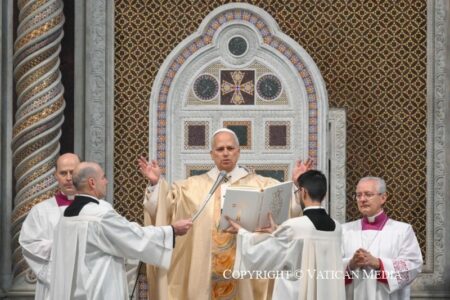
Leo made his appeals from the window of the papal apartments in the Apostolic Palace, after celebrating Mass on the other side of Rome’s historic city center in the cathedral archbasilica of St. John Lateran, to mark the feast of its dedication.
“This Basilica,” Leo said in his homily, “in fact, the ‘Mother of all Churches’, is much more than a monument or a historical memorial. It is ‘a sign of the living Church, built with chosen and precious stones in Christ Jesus, the cornerstone’.”
Pope Leo XIV celebrates Mass in the cathedral archbasilica of Jon Lateran in Rome, 9 Nov. 2025. (Image credit: Vatican Media.)
“As such,” Leo said, “it reminds us that we too are ‘living stones here on earth… built into’ a spiritual temple.”
“In recent years,” Leo noted, “the image of a ‘construction site’ has often been used to describe our ecclesial journey.” Leo said the description “is a beautiful image that speaks of activity, creativity and dedication, as well as hard work and sometimes complex problems to be solved.”
“It captures the concrete, tangible efforts of our communities as they grow every day, sharing their charisms under the guidance of their pastors,” he said.
“The Church of Rome, in particular, stands as a witness to this in the current implementation phase of the Synod. What has matured over years of work now needs to be put to the test and evaluated ‘in the field’,” Leo also said.
“This implies an uphill journey,” the pontiff added, “but we must not be discouraged. Instead, we should continue with confidence in our efforts to grow together.”
Leo also remarked how the construction “of the majestic building in which we find ourselves has had its share of critical moments, delays and changes to the original plans,” and yet, “thanks to the tenacity of those who came before us, we can now gather in this wonderful place.”
“In Rome,” Leo said, “a great good is growing thanks to the efforts of many. Let us not allow fatigue to prevent us from recognizing and celebrating this good, so that we may nourish and renew our enthusiasm.”
“After all,” the pontiff went on to say, “it is through charity in action that the face of our Church is shaped, making it ever clearer to all that she is a ‘mother’, the ‘mother of all Churches’, or even a ‘mom’, as Saint John Paul II said when speaking to children on this very feast day,” in 1986.
“I am close to the populations in the Philippines, hit by a violent typhoon,” Pope Leo XIV said in remarks following the traditional Sunday Angelus prayer in Rome. “I pray for the dead and for their families, for the injured, and for the displaced.”
Leo also prayed for victims of war everywhere in the world, and particularly for peacemakers everywhere at work in the world today.
“I express my heartfelt appreciation for all who, at every level, are committed to building peace in the many regions scarred by war,” the pontiff said. “In the past few days, we have prayed for the dead,” he said – November is a month specially given to prayer for the deceased – noting also how “among the dead are so many killed in combat and bombardments, even though they were civilians, children, the elderly, the sick.”
“If one would truly honor their memory,” Leo said, “let [belligerents] cease fire and put every effort into negotiation.”
Leo also noted the Italian bishops’ Day of Thanksgiving, an initiative encouraging “responsible care for the land,” especially efforts to contrast food waste and adopt sustainable agricultural practices.
“Let us thank God,” Leo said, quoting Saint Francis of Assisi’s Canticle of the Creatures, “for ‘our sister, Mother Earth’, and for all who cultivate and care for her.”
Leo made his appeals from the window of the papal apartments in the Apostolic Palace, after celebrating Mass on the other side of Rome’s historic city center in the cathedral archbasilica of St. John Lateran, to mark the feast of its dedication.
“This Basilica,” Leo said in his homily, “in fact, the ‘Mother of all Churches’, is much more than a monument or a historical memorial. It is ‘a sign of the living Church, built with chosen and precious stones in Christ Jesus, the cornerstone’.”
Digging “within ourselves and around us” so that we can then look to Christ and thus build “with humility and patience,” as “the millennial history of the Church” teaches us, a “true community of faith, capable of spreading charity, promoting mission, proclaiming, celebrating, and serving that apostolic Magisterium of which” the Basilica of St. John Lateran “is the first seat.” Pope Leo XIV reflected on the mission of the Church as a community of active believers in his homily during Mass on the occasion of the Dedication of the Lateran Basilica,celebrated on Sunday, 9 November.
In the presence of some 2,700 people, the Pope recalled the important history of the Cathedral, built at the behest of the Roman Emperor Constantine after he granted Christians freedom of worship in 313 AD, and then dedicated by Pope Sylvester I a few years later. However, Pope Leo XIV emphasised that this Basilica, the “Mother of all Churches,” “is much more than a monument or a historical memorial” but is instead “a sign of the living Church, built with chosen and precious stones in Christ Jesus, the cornerstone.” This “reminds us that we too, are ‘living stones here on earth… built into’ a spiritual temple,” he continued. “It is the ecclesial community, ‘the Church, the society of believers, [which] gives the Lateran its most solid and striking external structure’,” he explained, quoting St Paul VI.
Brothers and sisters, as we diligently labor in the service of God’s Kingdom, let us be neither hasty nor superficial. Let us dig deep, unhindered by worldly criteria, which too often demand immediate results and disregard the wisdom of waiting.
Concelebrating with Pope Leo at the altar were Cardinal Baldassare Reina, Vicar General for the Diocese of Rome and Archpriest of the Basilica of St. John Lateran; and Bishop Renato Tarantelli Baccari, Titular Bishop of Campli and Vice-Gerent of the Diocese of Rome. Approximately 160 priests and 10 Bishops also concelebrated.
In order to build, we must first look to Christ
The Pope began his reflection with the foundations of the Basilica of St. John Lateran. “Their importance is obvious and, even somewhat unsettling,” he explained, adding that those who built the Cathedral of Rome laid a sufficiently solid foundation on which to erect everything else, “digging deep, with great effort,” in this way preventing the structure from collapsing over time. For the Pope, this is a useful image because we too, “labourers in the living Church, we too must first dig deep within ourselves and around ourselves before we can build impressive structures.” Pope Leo quoted the second reading of the liturgy, taken from the first letter of St. Paul the Apostle to the Corinthians, in which he says that “no one can lay any foundation other than the one that has been laid; that foundation is Jesus Christ.”
This means constantly returning to Jesus and his Gospel and being docile to the action of the Holy Spirit. Otherwise, we risk overloading a building with heavy structures whose foundations are too weak to support.
The Church as a construction site
The Pope then moved on to the Gospel proclaimed during Mass, taken from the Evangelist St Luke. In it, Zacchaeus, a “rich and powerful man” who “feels moved to meet Jesus,” climbs a tree to see Him among the crowd, “an unusual and inappropriate gesture for someone of his rank who is accustomed to getting whatever he wants at the tax office as though it were his due.” Pope Leo pointed out that for Zacchaeus “climbing among the branches” meant “his own limitations and overcomes the inhibitions of his pride.” In the event, he was able to encounter Jesus, an encounter that “marks the beginning of a new life” for him.
When Jesus calls us to take part in God’s great project, He transforms us by skillfully shaping us according to His plans for salvation. In recent years, the image of a “construction site” has often been used to describe our ecclesial journey. It is a beautiful image that speaks of activity, creativity and dedication, as well as hard work and sometimes complex problems to be solved.
In Rome, a great good is growing
For the Pope, this image of the construction site “expresses the real, palpable effort with which our communities grow every day, sharing charisms and under the guidance of their pastors.” He also recalls how, even in the history of the Basilica of St. John Lateran, “there were critical moments, pauses, and corrections to projects in progress.’ Yet, he continues, ‘thanks to the tenacity of those who came before us, we can gather in this wonderful place.”
In Rome, a great good is growing thanks to the efforts of many. Let us not allow fatigue to prevent us from recognizing and celebrating this good, so that we may nourish and renew our enthusiasm. After all, it is through charity in action that the face of our Church is shaped, making it ever clearer to all that she is a “mother,” the “mother of all Churches,” or even a “mom,” as Saint John Paul II said when speaking to children on this very feast day.
He then reflected on how the Church of Rome is currently experiencing the “implementation phase of the Synod,” in which “what has matured over years of work now needs to be put to the test and evaluated ‘in the field.’” “This implies an uphill journey, but we must not be discouraged,” he said, adding that “instead, we should continue with confidence in our efforts to grow together.”
The importance of liturgy
Finally, Pope Leo highlighted “an essential aspect of the mission of a cathedral,” namely the liturgy, “the summit toward which the activity of the Church is directed… the source from which all its power flows.” For the Pope, all the themes he highlighted in his homily are found therein: “We are built up as God’s temple, as His dwelling place in the Spirit and we receive strength to preach Christ in the world.”
Therefore, care for the liturgy, especially here at the See of Peter, must be such that it can serve as an example for the whole people of God. It must comply with the established norms, be attentive to the different sensibilities of those participating and keep with the principle of wise inculturation (cf. ibid., 37-38). At the same time, it must remain faithful to the solemn sobriety typical of the Roman tradition, which can do so much good for the souls of those who actively participate in it.
Quoting St Augustine’s Discourses, in which he says that “beauty is nothing but love, and love is life,” Pope Leo emphasised that in the liturgy “this truth is emphasized in an eminent way.” He expressed his hope that “every care be taken to ensure that the simple beauty of the rites expresses the value of worship for the harmonious growth of the whole Body of the Lord” so that “those who approach the altar of Rome’s Cathedral go away filled with the grace that the Lord wishes to flood the world.”
On the occasion of the six-month anniversary of the election of Pope Leo XIV, Vatican Radio – Vatican News is releasing Leo from Chicago, a documentary retracing the story, family roots, studies, and Augustinian vocation of Robert Francis Prevost in his native United States. The journey unfolds from his childhood in Dolton, through the memories of his brothers Louis and John, and continues among schools and universities, communities and parishes, featuring the voices of confreres, teachers, classmates, and longtime friends.
Leo from Chicago follows the June release of the documentary León de Perú, which focused on the future Pope’s missionary years in Peru. It is produced by the Vatican’s Dicastery for Communication, in collaboration with the Archdiocese of Chicago and Apostolado El Sembrador Nueva Evangelización (ESNE). Leo from Chicago was produced by journalists Deborah Castellano Lubov, Salvatore Cernuzio, and Felipe Herrera-Espaliat, who traveled to the United States, with editing by Jaime Vizcaíno Haro.
At 6:00 p.m. Rome time CET on Monday, November 10, the documentary will be published on the Vatican News YouTube channel in three languages (English, Italian, and Spanish) and distributed through other international media outlets.
Whether designing algorithms for Catholic education, tools for compassionate health care, or creative platforms that tell the Christian story with truth and beauty, each participant contributes to a shared mission: to place technology at the service of evangelization and the integral development of every person,” the pope wrote.
Pope Leo’s message was read aloud Nov. 7 by Jesuit Father David Nazar during the 2025 Builders AI Forum, a two-day summit for idea-sharing and collaboration hosted at the Pontifical Gregorian University.
Since the beginning of his pontificate, the pope has emphasized the need for ethically grounded AI, but his message to the conference marked the first time he directly linked the technology’s promise to the church’s missionary work.
Forum organizers said the stakes are high, as AI tools increasingly shape how people seek meaning online.
“There are billions of people who do not yet know Christ and the truth that Christianity fully possesses,” said Matthew Sanders, a Catholic AI developer and one of the event’s organizers. “If the church’s guiding hand is not there, this technology has the power to do unimaginable harm, amplifying confusion and despair.”
Registration materials listed roughly 200 participants, including software engineers, venture capital partners, Catholic media producers, bishops and Vatican communications officials. The forum was structured as a working summit rather than a public conference, with most discussions held in small-group workshops.
The registration list included representatives from Microsoft, Palantir Technologies and Goldman Sachs, alongside Catholic filmmakers and ministry leaders. Actor and producer Lorenzo Henrie — who is currently co-financing and starring as an apostle in Mel Gibson’s “The Resurrection of the Christ,” now filming in Italy — was also listed among those participating.
After opening remarks, participants broke into six working groups, each tasked with addressing a specific challenge. Topics ranged from AI in Catholic education to whether the church should attempt to devise a “Catholic Turing Test” for identifying signs of consciousness in advanced systems.
Interest appeared particularly strong in the “Building and Scaling Catholic AI” workshop, which drew about half of the forum’s participants, and was focused on using AI for evangelization.
“We’re starting to leverage AI to impart the truth of the Catholic faith,” Sanders told Catholic News Service Nov. 6. “But there’s more to the faith than just imparting truth. There’s the pastoral, human dimension,” he said.
A recurring concern was how to help people move from digital encounters with Catholic content into lived parish life.
Sanders noted that many users first encounter Catholic teaching through apps such as Hallow or Magisterium AI. Without support, he said, new believers may struggle to find a worshiping community.
“The question is how do we ‘off-ramp’ people from products like Magisterium AI and help ensure that they can find either a community or show them how the faith is lived,” Sanders said.
The goal, he added, is to connect people to a tradition or practice that resonates — whether Eucharistic adoration, charismatic Mass or the Latin Mass — so they are accompanied rather than left isolated.
In another workshop, “AI for Faithful Christian Storytelling in Media,” filmmakers, writers and digital creators discussed how AI might help broaden the reach of Catholic narratives.
For Eike Petersen of Aid to the Church in Need, the problem is not a lack of meaningful stories but a lack of visibility.
“From a communications perspective, there’s so much good work the church is doing for persecuted Christians around the world,” Petersen told participants. “But this is really something I think we can scale with AI.”
Petersen said he hoped the workshop would clarify “what the technology is that’s needed for that and how to approach it,” particularly in regions where digital outreach could expand awareness and solidarity.