
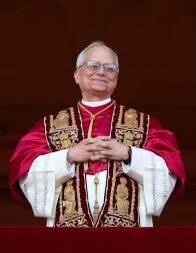
As Pope Leo XIV leads the Way of the Cross on Good Friday evening, Christians gathered at the Colosseum and spread across the globe will be led in spirit by the reflections of Fr. Francesco Patton, former Custos of the Holy Land, OFM.
At each of the fourteen stations of the Via Crucis, Fr. Patton’s words explore different aspects of Christian life in light of the Gospel readings and excerpts from the writings of St. Francis, as the Church marks 800 years since his death.
In his meditations, released by the Holy See Press Office earlier on Friday, Fr. Patton takes us along Jesus’ original path through the narrow streets of Jerusalem up to Golgotha for His crucifixion and burial.
“This route is not reserved for the devout or those seeking a quiet space for prayer,” he says in his introduction. “Rather, as in the time of Jesus, we find ourselves walking through a chaotic, distracting, and noisy environment, surrounded by people who share our faith in Him, but also by those who deride or insult Him. Such is the reality of our daily life.”
“The Way of the Cross is not intended for those who lead a pristinely pious or abstractly recollected life,” says Fr. Patton. “Instead, it is the exercise of one who knows that faith, hope and charity must be incarnated in the real world”.
As Jesus is condemned to death in the first station, we watch Him unmask “every human presumption of power” and the temptation to abuse power, even though it was given by God.
“St. Francis of Assisi,” says Fr. Patton, “reminds us that every person in authority will have to answer to God for the way they exercise their power,” as they start or end wars, sit in judgment, engage in economic activity, or promote or destroy human dignity.
As Jesus takes up His cross in the second station, we feel repulsion and a desire to flee from any form of pain or ignominy.
“Free us, Jesus, from fear of the cross,” prays Fr. Patton. “Give us the grace to follow the path you trod and to seek no glory other than in your cross.”
As Jesus falls in the third station, we are reminded that Jesus’ life was of “continual abasement and lowliness,” since He divested Himself of His glory to become man.
“This fall is a foretaste of an even deeper descent,” says Fr. Patton: “The descent into the realm of the dead and a surrender to the enigma of death—the fall that awaits each of us at the end of this earthly life.”
As Jesus meets His mother at the fourth station, we encounter the unnatural and unimaginable pain of all mothers who endure the death of their children, whether by illness, accident, violence, or despair.
“Grant us a maternal heart,” prays Fr. Patton, “that we may understand and share in the suffering of others, and learn, in this way too, what it truly means to love.”
As Jesus receives help carrying His cross from Simon of Cyrene at the fifth station, we understand that even if Simon did not volunteer to help Jesus, those steps alongside Him changed his life forever and led him to teach his own sons to bear witness to Christ.
“Even today, there are many people throughout the world who choose to do good for others,” recalls Fr. Patton. “Many of them do not even believe in you, and yet—even unknowingly—they help you carry the cross.”
As Veronica wipes Jesus’ face at the sixth station, we witness her simple yet profound gesture of charity, through which she became the guardian of His image as the Man of Sorrows.
“Make us capable of wiping your face today,” says Fr. Patton, “still covered with dust and blood, still disfigured by every act that tramples upon the dignity of the human person.”
As Jesus falls the second time at the seventh station, we see that great love is stronger than death and reveals that love itself draws us into the very life of God.
“When you fall,” notes Fr. Patton, “you do so to raise up those who are crushed to the ground by injustice, by falsehood, by every form of exploitation and violence, and by the misery produced by an economy that seeks individual profit rather than the common good.”
As Jesus meets the women of Jerusalem at the eighth station, we recall that women have always been present wherever there is suffering, taking to heart Jesus’ demanding words to take Him seriously.
“Give us tears once more, Lord,” prays Fr. Patton, “lest our conscience fade into the fog of indifference and we cease to be fully human.”
As Jesus falls the third time at the ninth station, we understand that it does not matter how many times we fall; what truly matters is that Jesus is there to lift us up once more with His mercy.
“You desire,” says Fr. Patton, “that each of us, at your side, may reach the Father and find life—true life, eternal life—the life that nothing and no one can ever take away from us.”
As Jesus is stripped of His garments at the tenth station, we remember that authoritarian regimes, the media’s indifference, and our own morbid curiosity repeat today that violation and strip others of their human dignity.
“Remind us, Lord, that each time we fail to recognize the dignity of others, our own dignity is diminished,” prays Fr. Patton.
As Jesus is nailed to the cross at the eleventh station, we understand that true power is not force or violence, but rather the power of love to take upon ourselves the evil of humanity and destroy it with our forgiveness.
“You are King and you reign from the cross,” says Fr. Patton. “You do not resort to the supposed power of armies, but to the apparent powerlessness of love, which allows itself to be nailed to the cross.”
As Jesus dies on the cross at the twelfth station, we witness that His mission has been completed, as He returns to the Father and brings us with Him.
“We stand before the One who, in fulfilling the purpose of the Incarnation, opens for us the path to fulfill the deepest meaning of our own lives: to become children of God, to be His masterpiece,” says Fr. Patton.
As Jesus is taken down from the cross at the thirteenth station, we see His death begin to bear its first fruits in Joseph of Arimathea’s and Nicodemus’ courage to approach Pilate and lay Jesus’ body to rest in dignity and reverence.
“Even in death,” notes Fr. Patton, “the human body retains its dignity and must not be desecrated, hidden, destroyed, withheld, or denied a proper burial.”
As Jesus is laid in the tomb at the fourteenth station, we return to the Garden of Eden, where our first parents received the gift and responsibility to care for their home but lost it through their failure to trust in God.
“Here,” concludes Fr. Patton, “Mary Magdalene received her mission to proclaim that death has been conquered: Jesus of Nazareth has risen; He is the Lord, the living One who dies no more.”
At the conclusion of the Way of the Cross, Pope Leo XIV prays that Christians may respond to St. Francis’ invitation to “live our lives as a journey of ever-deepening participation in the communion of love that unites the Father, the Son, and the Holy Spirit.”
Way of the Cross Meditations: ‘Faith, hope, love must be incarnated in real world’
03 Friday Apr 2026
NEWS