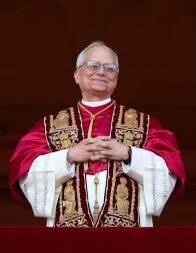
It marked the Holy Father’s first encounter since being elected Pope with officials of the Roman Curia, and the employees of the Holy See, the Governorate of Vatican City State, and the Vicariate of Rome.
Recognizing that each, in his or her own way, collaborates in the Successor of Peter’s work, the Pope warmly welcomed those gathered, and expressed his gladness.
“Each one contributes by carrying out their daily tasks with commitment—and also with faith, because faith and prayer are like salt in food: they give it flavor.”
The Holy Father also said he was very glad that many family members were also present, “taking advantage of the fact that today is Saturday.”
This first meeting of ours, Pope Leo XIV noted, is “certainly not the occasion for programmatic speeches,” but rather “an opportunity for me to thank you for the service you carry out, and this service, which I, so to speak, ‘inherit’ from my predecessors.”
The Holy Father pointed out that he arrived only two years ago, “when the beloved Pope Francis appointed me Prefect of the Dicastery for Bishops.” At that time, he recalled that he left the Diocese of Chiclayo in Peru and came here to work.
“What a change! And now… what can I say? Only what Simon Peter said to Jesus by the Sea of Tiberias: ‘Lord, you know everything; you know that I love you,'” he reflected.

Pope Leo receives curial officials (@VATICAN MEDIA)
Popes come and go, Curia remains
“Popes come and go; the Curia remains,” Pope Leo observed.
This, he said, applies in every particular Church, to diocesan Curias, and it applies as well to the Curia of the Bishop of Rome. “The Curia is the institution that preserves and transmits the historical memory of a Church, of the ministry of its Bishops,” he noted, saying, “This is very important.”
Memory, he reiterated, is an essential element in a living organism, and is not only oriented toward the past, but nourishes the present and guides the future. “Without memory,” he said, “the path becomes lost, the journey loses its meaning.”
Cannot thank the Lord enough for vocation
Working in the Roman Curia, he said, means helping to keep alive the memory of the Apostolic See, so that the ministry of the Pope may be carried out in the best possible way. And by analogy, he added, the same can be said of the services of the Vatican City State.
He then highlighted the missionary dimension of the Curia and of every institution linked to the Petrine ministry, complementary to that of memory,.
“As you may know,” he shared, “the experience of mission is part of my life—not only as a baptized person, as it is for all Christians—but also because, as an Augustinian religious, I was a missionary in Peru. It was among the Peruvian people that my pastoral vocation matured.”
“I can never thank the Lord enough for this gift!”